Highly Composite Mornings, Prime Afternoons
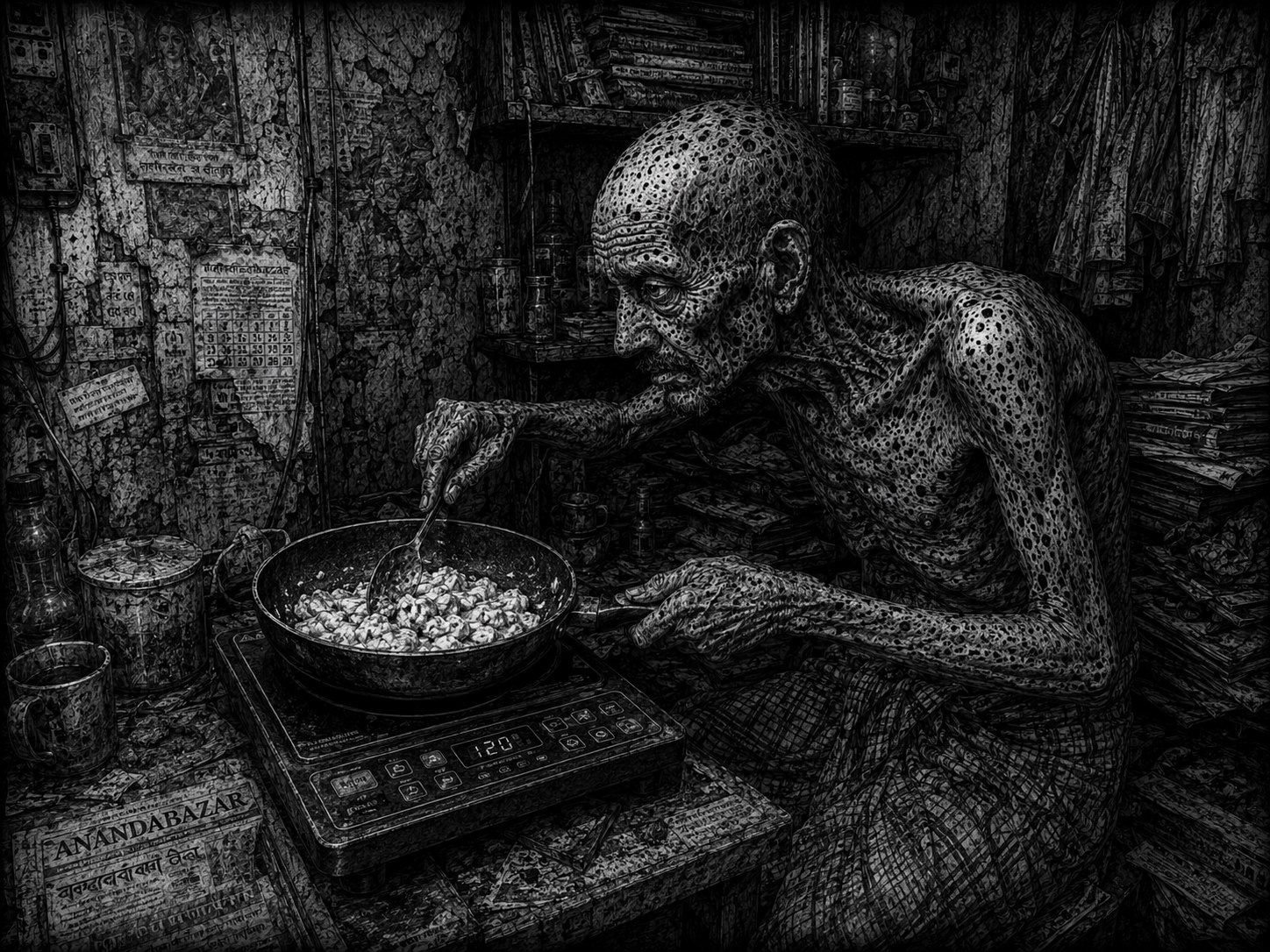
Highly Composite Number [HCN, a number with more divisors than any smaller positive integer before it]
Life Insurance Corporation [LIC, the old Indian insurance institution whose policies have entered family conversation like weather, blood pressure, and marriage proposals]
By eleven in the morning, the sweat under my left armpit had formed a small independent republic.
It had humidity, corruption, poor drainage, and the sort of governance one associates with a municipality that has misplaced both the file and the table on which the file was last seen. The rice cooker clicked. A noble sound. In a better household, it would mean lunch. In mine, it often means surrender has reached the kitchen.
I sat in my rented South Calcutta heat-box, fan turning above me like an elderly philosopher who has seen too much and achieved too little, and thought of Srinivasa Ramanujan.
This is one of the punishments of having an educated but unstable brain. It will not simply say, “You are depressed. Go bathe. You smell like a historical event.” No. It must import number theory, Madras, Cambridge, colonial weather, and one dying genius into a room where the main engineering problem is whether the dal has enough salt.
Ramanujan, that impossible young man from Kumbakonam, did not see numbers as dead marks on paper. He saw them as creatures. Some fat, some sly, some lonely, some over-friendly, some with trapdoors in the basement. Other men inspected mangoes this way. Ramanujan inspected integers.
In 1915, he wrote about highly composite numbers. The idea is simple enough to enter through the front door without removing its shoes. A highly composite number has more divisors than any smaller number before it.
Take 60.
Lovely number.
It can be divided by 1, 2, 3, 4, 5, 6, 10, 12, 15, 20, 30, and 60. A little Esplanade tram depot of divisibility. Everything has a route into it. Everybody knows somebody there.
Naturally, my brain said: yes, that is mania.
Not joy.
Not genius.
Not the cinema version of madness where a pale man writes equations under lightning while violins confess on his behalf.
Mania is large because too many things divide into it.
One thought divides into four. Four into sixteen. Sixteen into a procession of plans, grudges, sudden theories, unpaid invoices, kitchen inventories, memories of a woman’s shoulder from 1993, dental anxiety, political annoyance, sexual absurdity, business schemes, old humiliations, new websites, and one urgent need to reorganize spoons according to moral character.
A manic morning is a highly composite morning.
Everything enters.
Tea enters. Shame enters. Libido enters. A half-written essay enters. A WhatsApp message left unread enters. Mother’s medicine enters. The smell of frying posto from next door enters. Some news about artificial intelligence eating jobs enters, though it has not yet shown any interest in doing my laundry. Global capitalism enters, wearing sunglasses. Childhood enters without knocking. The rice cooker clicks again, as if taking minutes.
And there I am, a 51-year-old lower-middle-class Bengali man in the southern fringe of Calcutta, wondering whether sitting upright for twenty minutes might still convert me into a man of consequence, instead of a human appendix attached to an electricity bill.
This is the grandeur of a disordered mood.
It makes the ordinary too available.
The chair is not a chair. It becomes poverty, spine, foam, aging, office furniture, vanished ambition, and the tragic geometry of a man’s backside negotiating peace with bad upholstery.
The ceiling fan is not a ceiling fan. It becomes childhood summer, load shedding, angular momentum, dust, landlord neglect, and the faint possibility that one day the blade will detach and settle several philosophical questions at once.
The spoon is not a spoon. It is bachelorhood, cheap steel, lunch, hygiene, class, habit, and the suspicious fact that some people in this world own matching cutlery while I own objects that appear to have survived three governments and a train accident.
One thought has a hundred divisors.
That is mania at street level.
Too many doors. Too many routes. Too many relatives arriving without invitation, sitting on the bed, and asking for tea.
Ramanujan had Hardy.
I have Google Sheets and acidity.
Hardy could look at Ramanujan’s wild mathematical claims and say, this one is true, this one needs proof, this one is astonishing. I look at my morning thoughts and say, this one is an essay, this one is a revenge fantasy, this one is a startup idea, this one is lust wearing a professor’s coat, this one is a bad financial decision, and this one should be buried quietly before relatives hear of it.
Then depression comes.
Depression is prime.
Not prime as in excellent. Not prime as in prime minister. Not prime as in fresh hilsa before some criminal freezes it and later sells it as heritage.
Prime in the arithmetic sense.
Divisible only by one and itself.
2, 3, 5, 7, 11, 13.
Hard little bachelors.
A prime number stands alone. Try dividing 13 by 2. No. By 3. No. By 4. No. By 5. No. It remains itself, like a stubborn old uncle with a towel over his shoulder refusing medical advice until his sugar levels acquire diplomatic recognition.
Depression is like that.
You cannot divide it into manageable pieces.
People say, “Go for a walk.”
No.
“Call someone.”
No.
“Take a bath.”
No.
“Do one small task.”
No.
“Think positive.”
At this point, the prime number should be allowed to slap the sentence with a wet gamcha.
A depressed day is not divisible by errands, hygiene, ambition, romance, duty, patriotic uplift, chanting, productivity videos, or those clean-faced motivational men who tell you to wake at five while clearly having a father who owned three garages, two mango orchards, and a moral vocabulary imported from a gymnasium.
Depression is 17.
It sits there.
One body. One room. One thought.
No side door. No back lane. No friendly neighbor saying, “Come, have tea.”
You think mania and depression are opposites. That is the easy map. Day and night. Tea and coffee. Satyajit Ray and the average Bengali wedding video where the drone shot appears to have been taken by a migratory bird with vertigo.
But inside the skull, they are not opposites.
They are two different arithmetic punishments.
Mania says: everything connects.
Depression says: nothing connects.
Mania is over-factorized reality.
Depression is indivisible despair.
And normal life, if such a thing exists, may simply be a modest composite number. Perhaps 12. Perhaps 18. Respectable numbers. Useful numbers. Numbers that can pay rent, cook dal, reply to email, buy medicine, and speak to clients without sounding either like a prophet or a corpse.
I have not lived much in 12.
I have visited 12. I have taken tea there. I admired the curtains. Then some chemical contractor inside the brain began shouting, and the number changed.
This is what healthy people often miss. They think mood is weather in the decorative sense. Cloud, rain, sunshine, rainbow, umbrella, inspirational caption.
No.
Mood is arithmetic imposed on the body.
Some days your life has too many divisors. The kettle whistles and suddenly you are thinking of steam engines, British trade, childhood kitchens, your dead father, James Watt, boiling water, unpaid work, and whether your entire life has become a pressure cooker without a whistle.
Some days your life has no divisors. The toothbrush cannot enter. The phone cannot enter. Music cannot enter. Even hunger stands outside the gate with a file and is told, “Come Monday.”
The body becomes a number.
The stomach is a denominator.
The bladder is a remainder.
The heart is a theorem written badly in a notebook found after the author has died broke, tired, misunderstood, and possibly constipated.
I am not comparing myself to Ramanujan.
Let us settle this before some neat gentleman adjusts his spectacles and prepares a footnote. Ramanujan was a genius. I am not. I am not even the man who sharpened Ramanujan’s pencil. I am a middle-aged Bengali man trying to survive heat, debt, loneliness, medicine strips, unpaid consulting, cheap rice, and the insult of still having a mind that occasionally wants to dance when the rest of the organism wants to lie face down like a defeated mosquito.
But numbers sometimes understand better than people.
People arrive with advice already leaking from the mouth.
“Be strong.”
“Don’t overthink.”
“Everyone has problems.”
“Marriage would have helped.”
“Do yoga.”
“Go to temple.”
“Think of poor people.”
I am poor people, you devotional cabbage.
Not cinema poor. Not photogenic poor. Not poor with sunlight on cheekbones and a violin somewhere in the background. Just boringly poor. Spreadsheet poor. Rice-cooker poor. Medicine-strip poor. Dental-implant-postponed-until-the-jaw-becomes-archaeology poor.
And in that poverty, arithmetic becomes intimate.
A manic thought is a bazaar.
Hawkers everywhere. Every idea shouting discount. Buy one theory, get two delusions free. Philosophy near the drain. Politics beside the fish. Science hanging from a plastic rope. Desire wrapped in old newspaper. Memory bargaining over coriander. You walk through it and feel briefly alive, but also pickpocketed by your own neurons.
A depressed thought is a locked warehouse.
No light.
No stock.
No clerk.
Only dust.
The funny thing, or not funny, but let us call it funny because otherwise one must scream into the dal, is that society rewards the highly composite performance and punishes the prime interior.
If you can appear divisible, you are considered functional.
Divisible by clients.
Divisible by relatives.
Divisible by landlords.
Divisible by platforms.
Divisible by banks.
Divisible by polite messages, deliverables, phone calls, invoices, and cheerful nonsense written in the voice of a man whose soul is apparently wearing formal shoes.
But when you become prime, when nothing can enter and nothing can be extracted, you are called lazy, negative, unstable, difficult.
The market loves composite men.
It hates primes.
A prime man cannot be processed. He cannot be divided neatly into productivity, family duty, neighborhood masculinity, LinkedIn enthusiasm, or the traditional Bengali expectation that a man must earn, marry, reproduce, repair switches, know LIC policies, shout at plumbers, and die with a bank passbook under his pillow like a patriotic biscuit.
So he sits.
Prime.
Awful.
Whole in the worst possible way.
Depression gives you a terrible unity. Shame, fatigue, fear, memory, heat, hunger, and loneliness collapse into one black paste. Like the inside of a drain after monsoon, except with more philosophy and less public funding.
Mania gives you terrible plurality. You become a committee meeting inside a burning tram. Everyone has a motion. Everyone has an amendment. Someone is singing. Someone is taking off his shirt. Someone has discovered a new economic theory using coconut sellers, electricity bills, and the price of fish as evidence.
And I, chairman of this neurological municipality, have lost the bell.
There are medicines, yes. Doctors, yes. Sleep rules, yes. Warnings, routines, blood tests, charts, mood logs, alarms, the whole modern bureaucracy of not going completely to pieces.
I respect it.
I need it.
I am alive partly because some chemistry has been persuaded to behave like a tired schoolteacher.
But still the numbers come.
Some mornings I wake highly composite, divisible by every wound.
Some afternoons I become prime, divisible by nothing, not even pity.
At night, when Calcutta becomes slightly less homicidal and the dogs begin their municipal conference, I think of Ramanujan seeing numbers as living things.
Perhaps 36 was a fat uncle.
Perhaps 7 was a monk.
Perhaps 1729 was not merely a taxi number but a private joke the universe told two exhausted men in a hospital room.
And perhaps my own mind, this cracked brass lota of heat, memory, mucus, mathematics, hunger, desire, debt, and unfinished work, is not one ruined integer at all.
Perhaps it is a sequence.
Composite.
Prime.
Composite.
Prime.
A man changing factorization in bad light.
No redemption arrives. No neat lesson. No conference-stage fellow in sneakers telling me vulnerability is leadership. Only this: I tried to make tea, forgot the sugar, burned my finger on the pan, cursed several ancestors, remembered Ramanujan, and stood in the kitchen with one hand under tap water and one small spark of intellectual excitement.
At my age and income level, that is not exactly triumph.
But it is not nothing either.
P.S. References: Srinivasa Ramanujan, “Highly Composite Numbers,” Proceedings of the London Mathematical Society, 1915. G. H. Hardy, A Mathematician’s Apology, 1940.